
The Laboratory
on the Air
A flying laboratory
that listens to the sky.
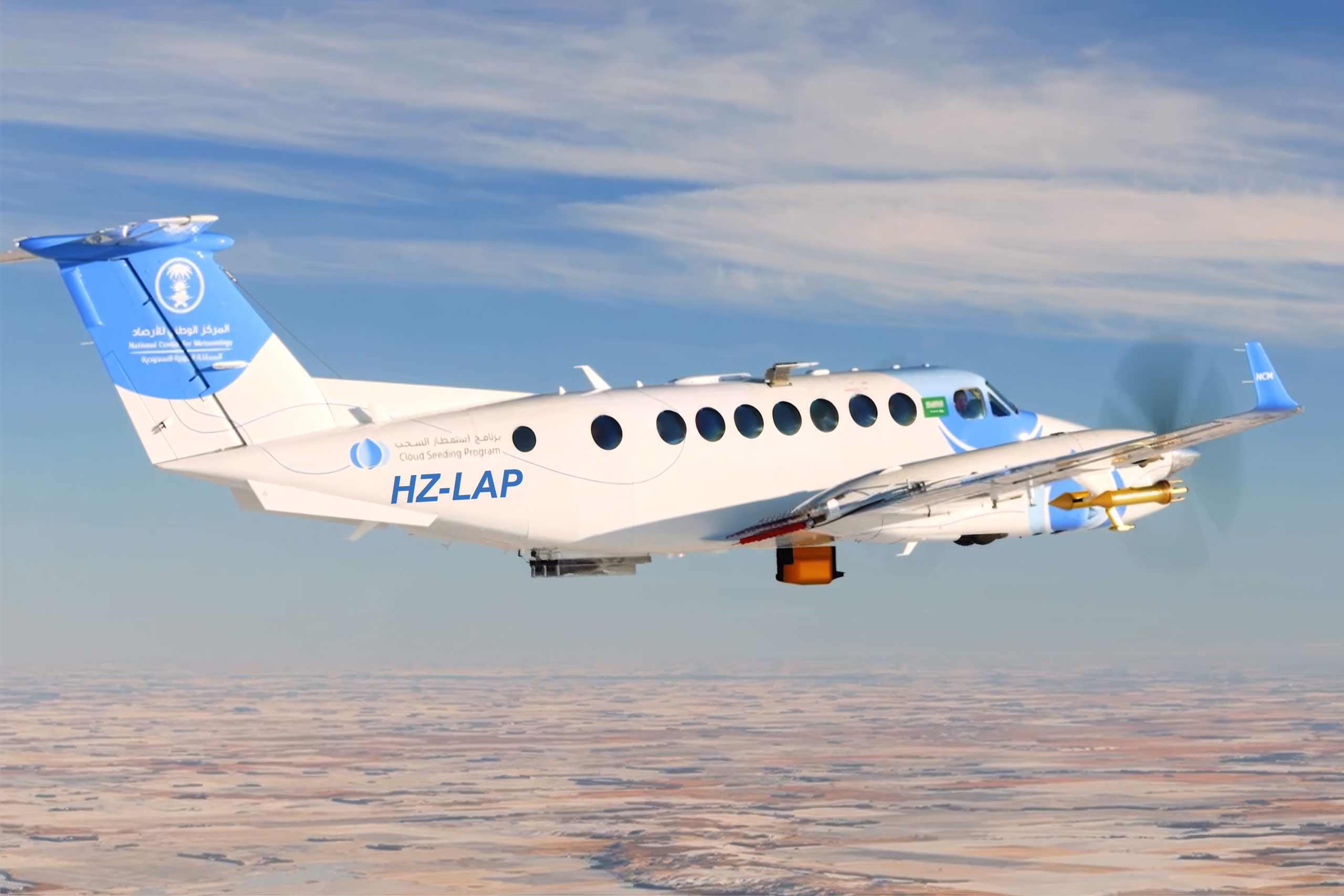
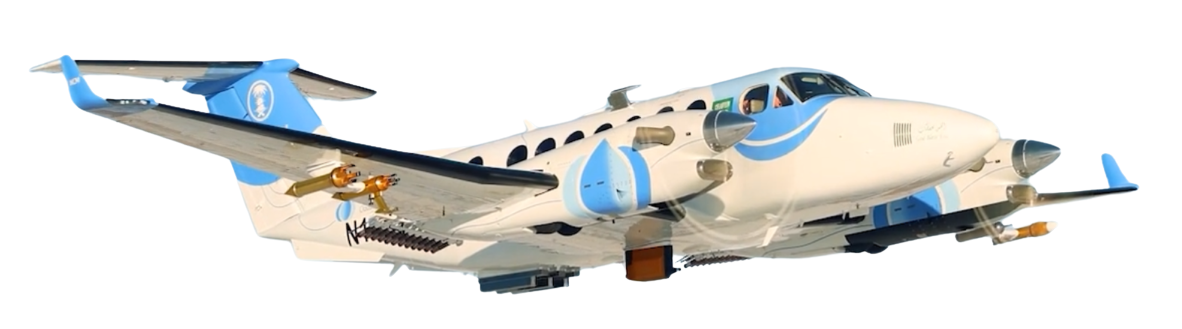
The NCM King Air 360 (KA360) is a specially modified airborne research laboratory designed to conduct high-resolution, in-situ atmospheric observations. By flying directly through weather systems, the aircraft performs simultaneous measurements of cloud microphysical properties, aerosol characteristics, and meteorological parameters, providing critical scientific guidance for cloud-seeding operations aimed at enhancing precipitation over the Kingdom of Saudi Arabia.
Numerous instruments. One cloud.
Particle by Particle.
CCN Counter
Counts cloud-condensation nuclei…
Research aircraft.
in operation.
The morning forecast
Forecasters identify the day's most promising convective cells. The science lead and pilot agree on intercept altitudes, holding patterns, and the seeding signal that will trigger flare release.
Instrument Preperation
Each of the fourteen onboard instruments is powered, calibrated against a known reference, and time-synced to the aircraft data bus. The flare rack is loaded with up to forty-eight hygroscopic salt flares.
360 in Operation
The 360 climbs through the lower troposphere, instruments live, sampling the ambient aerosol baseline before contact with cloud. Above 14,000 ft, the team begins their first transect of the target cell.
The Aircraft Operator & data monitor
At the cloud's updraft base, the pilot ignites a sequence of salt-aerosol flares. Microphysics probes record the moment droplet spectra widen — the cloud's first response to its new condensation nuclei.
The cloud, changed
Seven minutes after the flare burn, the aircraft returns through the seeded plume. The 2D-S imaging probe captures crystals an order of magnitude larger than baseline — proof that microphysics has shifted.
Scientists and researchers
Engines cool on the apron. The science team transfers the day's flight data — drop spectra, vertical winds, ice crystal images — into the program archive, where it begins the long process of becoming science.